Art Submission Guidelines
Please review the following guidelines before submitting your artwork. Following these guidelines will help ensure your order is produced accurately and on schedule.
Jump To A Section
Requirements by Print Method
Different print methods and product types have different artwork requirements. Below is a general guide for each method:
Screen Printing / Silk Screening
Requires vector artwork (AI, EPS, PDF). Each color in your design requires a separate screen, so designs should use a limited number of colors. Halftones and gradients may not reproduce well depending on the product.
Raster artwork is only accepted for photographs and other similar art. If you do not have a source for vector artwork, please contact our sales staff.
Full Color Process (Digital) Printing
All jobs require vector or raster artwork
Vector artwork is preferred for accuracy and detail If raster artwork is the only artwork type available, minimum of 600dpi.
Software & File Format
The following file formats are accepted, listed in order of preference:
| Format | Software | Type |
|---|---|---|
| .AI | Adobe Illustrator | Vector (Preferred) |
| .EPS | Various | Vector |
| .INDD | InDesign | Vector (Preferred)r |
| Various | Vector or Raster | |
| .PSD | Adobe Photoshop | Raster (300 DPI min) |
| .TIFF | Various | Raster (300 DPI min) |
| .PNG / .JPG | Various | Raster (300 DPI min) |
Adobe .pdf (Fonts must be converted) .tif (if raster is acceptable, see above) .jpg / .png / .gif / .tiff / .bmp
Vector Artwork Requirements
To avoid additional charges and additional time in production:
- Artwork must be submitted at the actual size of the finished product
- All fonts must be converted to outlines / paths
- All placed / linked images must be embedded or included separately
- All images must include the required and proper sized bleed
- All color copy or jpg indicating cut should be submitted for reference
- All spot colors should be specifically identified. Include white if necessary
- Cut / Die lines should always be clearly indicated with an unused spot color
Raster Artwork
Example: 300%
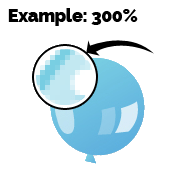
Raster artwork is an image composed of pixels. This creates an artwork image that is not scalable, editable or able to be spot color separated for reproduction.
Common Raster File Types: .jpg / .bmp / .psd / .tif / .pcx
Vector Artwork
Example: 300%
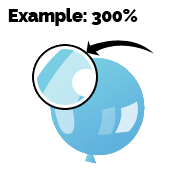
Vector artwork is created from mathematical points and paths. This creates a piece of artwork that is editable, scalable and able to be spot color separated for reproduction.
Common Vector File Types: .ai / .eps / .pdf / .fh / .cdr / .indd
Methods for Submitting Artwork
Preferred : Direct Email is the most preferable option (contact service)
Send your files to info@adinaline.com .
- Include a jpg or pdf for placement reference
- Convert all fonts to outlines / paths
- Include or embed all placed images
- Submit all artwork at 100% actual size
- Identify and correctly illustrate all spot colors
- Allow for a bleed if necessary
- Submit the original file, not a duplicate or copy
- Never flatten or merge layers on a photoshop file or tif
- Indicate the cut line and die line
- Verify that the art meets all of Adinaline's guidelines and expectations
Fonts & Text
All fonts used in your artwork must be converted to outlines (also called curves or paths) before submitting. This ensures that your text will appear exactly as intended, even if we do not have the same font installed on our systems.
If you are unable to convert fonts to outlines, please include the font files with your artwork submission so we can install them for production.
- Minimum recommended font size varies by product and print method. General recommendations:
- San Serif in All Caps (4 pt. Bold)
- Serif in All Caps (6 pt. to 8 pt. Bold)
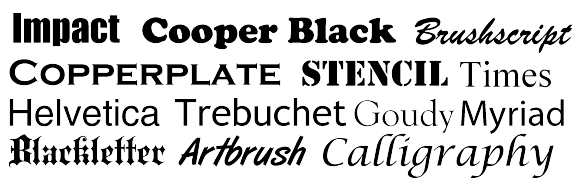
- Common Font Types:
- Very small or thin fonts may not reproduce well on certain products
- Bold, sans-serif fonts generally produce the best results on small items
- Always convert fonts to outlines before submitting vector files
Contrasting Colors
For the best results, ensure that your design uses colors with sufficient contrast. Light colors on a light background or dark colors on a dark background may not be visible on the finished product.
When selecting colors for your design, consider the following:
- Use dark text on light backgrounds and light text on dark backgrounds
- Avoid using similar colors adjacent to each other (e.g., light blue text on a medium blue background)
- Yellow and other light colors may not be visible on white or light-colored products
- Refer to our Stock Colors page to view available standard colors
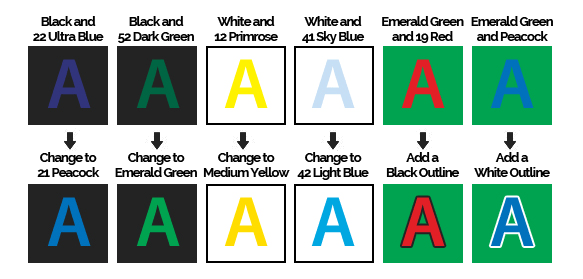
If you are unsure about your color choices, our art department will review your design and make recommendations to ensure the best possible outcome for your project.
Customer Help Portal
Use the below resources to aid your efforts!
- Art Templates Download art templates and guides
- Frequently Asked Questions Answers to our commonly asked questions
- Stock Colors View our standard production run colors
- Art Guidelines Tips and tricks for setting up and submitting
- Retail Flyers Printable PDF flyers for use with your clients
- Request Information Request additional information from us
- Upload Art Send us your artwork files for quoting
Company Information

ASI: #31971

SAGE: #69032